
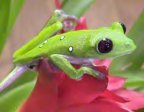
Agalychnis Callidryas∼Red Eyed Treefrog

The photo banner shows the different stages and colors that Agalychnis craspedopus goes through to reach adulthood, in order from left to right.
Hands down, one of the most lovely and widely photographed frogs in the world. The Greek words it derives its' name from translates into 'beautiful tree nymph.' Ranges of the entire species is from Veracruz, Mexico through Panama and Costa Rica. Despite its' delicate appearance, it is a fairly hardy treefrog.
The red eyed tree frogs lay their eggs in strands just above a rainforest pool, by wrapping a leaf into a funnel and depositing eggs inside. The eggs will soon develop into tadpoles, which will hatch and slip into the pool below. Males are smaller than females. It has been recorded that the more commonly kept South American Red-Eyed treefrog has lived to 6 years in captivity.
Setup
 The Red-Eyed Treefrogs are fairly active, so I suggest no less than a 29 gallon tank
to start off with. When you have over three of them, move up to a 50 gallon for the best
success. Lushly plant this frog's new home. I use different varieties of bromeliads
and hardy orchids like the 'Phalenopsis' spp. Drift wood at the back of the vivarium
can be affixed to cork board. (The cork board is slapped flush onto the back glass)
Then attach the bromeliads and orchids to the drift wood. A taller tank is recommended.
If you are able to, supply them with a 'waterfall' style stream that then tumbles into a
small pond at the vivarium's bottom floor. Use live moss or
dichondra
for a floor-covering.
The Red-Eyed Treefrogs are fairly active, so I suggest no less than a 29 gallon tank
to start off with. When you have over three of them, move up to a 50 gallon for the best
success. Lushly plant this frog's new home. I use different varieties of bromeliads
and hardy orchids like the 'Phalenopsis' spp. Drift wood at the back of the vivarium
can be affixed to cork board. (The cork board is slapped flush onto the back glass)
Then attach the bromeliads and orchids to the drift wood. A taller tank is recommended.
If you are able to, supply them with a 'waterfall' style stream that then tumbles into a
small pond at the vivarium's bottom floor. Use live moss or
dichondra
for a floor-covering.
These nocturnal
frogs can be viewed more often if you place a red light outside one corner of the tank
for use in evenings. Also provide adequate ventilation to ward off fungal or bacterial
infections.  78° to 80° in daytime is good, and between 72 ° and 75 ° in the evening.
Use a herp-style heat-mat to keep the temperature even.
To control the amount of heat emitted from under tank heaters make sure it has a
rheostat.
78° to 80° in daytime is good, and between 72 ° and 75 ° in the evening.
Use a herp-style heat-mat to keep the temperature even.
To control the amount of heat emitted from under tank heaters make sure it has a
rheostat.
Do not handle this anuran unless absolutely necessary, and then use Proper procedures.
Further Onsite Help
Basic Frogcare (choosing healthy frogs, species mixing, feeding, etc.)
Vivariums (to establish and maintain, lighting, substrate ideas, etc.)
Quarantine (keeping vivarium disease-free, how to set up quarantine tank)
Water 101 (How to establish & maintain high quality water)
Raising Insects (Info about raising your own insects, including grubs)
Frog Breeding (temperate style setup information)
